


 Mirrors, luggage, garment bags, thermos flasks...
 Floor mats, gym bags, reusable bottles, bricks…


 Gift vouchers


Promoting Bellydance and living from it : Hestia's exemplary journey
Thanks to Hestia, an oriental dance professional, for answering with passion and authenticity to our interview.
Can you tell us about the latest Bellydance show you created named "Oriental Odyssey"? What was its purpose and content?

Every 4 to 5 years, in Rouen (France), an exceptional event is held. It is the Armada (a gathering of famous boats from all over the world). This well-known international event brings together hundreds of thousands of visitors over 10 days and is a real source of pride for the city. Since the summer of 2022, I had been thinking about the subject: I dreamed of being able to participate with my choreographic workshops' dancers and perform a show there combining Bellydance and all the magic that can be imagined around the ocean.
It is with this in mind that at the beginning of the season, I started to imagine a 1st scene on this theme. At the start of 2023, we were lucky enough to be selected to participate in the activities during the Armada. My show "The Oriental Odyssey" naturally flowed from this, I chose to combine the Armada project with my end-of-year gala.From there, I looked, with the participation of the students from the workshops, for a show combining "Orient" and "ocean", and we chose the sailor Sindab's legend, appearing in the tales of the Arabian Nights.
We imagined that our sailor had to find a fantastic treasure sunk in the depths of the sea. The show's choreographies therefore represented his adventures as well as the obstacles to overcome to achieve his goal. Depending on the journey's stages, I derived choreographic styles and themes that seemed consistent to me.When Sindab had to leave his relatives to go to sea, I used classic songs on the theme of love and loss. When he had to sail through thick and thin, I put on choreography of sails and rhythmic music. To represent his encounters with fantastic sea creatures, the Isis wings were perfect. For the treasure keepers, I used saïdi with stick, sirens and fans. At the end of the show, we also staged the treasure chest found by Sindab.
This show is one of my greatest successes in terms of choreographic achievement. In total, 60 oriental dancers (12 groups of children, teenagers and adults) took the stage to perform 16 choreographies. It was magical!
How do you choose a theme for the show? How do you tell a story through oriental dance? What are the steps to follow to give meaning and a common thread to a show but also to ensure that the magic works for both the dancers who perform and the audience?
I work in 2 different ways to choose my show themes. It varies from year to year, depending on my desires but also on the time I have.
- Either, I start from my choreographies created during the year and I link them together, according to my inspiration, by a simple theme, broad but always related to the East. For example, for my show "The Palace of Wonders" in 2019, each group represented "a wonder". The students played a real role in the success of this show and got involved in the project. First, they had to find what their choreography, associated with the music and the costume, inspired in them. So we grouped together phoenixes, firefly fairies, dragons, magic instruments, sirens... Then, I offered them to write the texts of "transitions" (text which would present the choreography through the "wonder" chosen). To have a good dynamic in the show and keep the audience attentive, I also asked the students to record their voice or that of their loved one for each of these transitions. Honestly, we had a good laugh. Finally, it was also the girls who staged these transitional sequences. One of them played the "magic derbouka", another imitated the "eccentric cook"... others helped me to find representative objects such as the magic guitar, the flying carpets with fans... What an adventure this show was! I wanted it to be participative, leaving choices, possibilities, making creativity and imagination work... and everyone got on well.
- Or, and this is more complex for me, I start from a very precise story, and I derive essential choreographies from it for the running of the show. This requires starting to think about the choreographies from the start of the season, which is far from obvious when the groups are not formed yet.This was particularly the case for this year's show but also the one created in 2022 entitled "In the heart of Cairo". In the latter, we had followed a resident of Cairo in her city's discovery. I split the show into 4 main parts:
- "Arrival in Cairo": therefore I needed music representative of Egypt with great classics, a routine.
- "The souk": rhythmic and colorful choreography, with pop, saidi.
- "The palace" with softer passages or related to gods and goddesses: veils, Isis wings.
- "The district of the people" with Baladi and Shaabi.
The same way, I asked some students to write transitions which we then reworked together. I also requested for them to find musical tracks on which we were going to record our main character's voices.
In any case, to unfold a coherent story in a show, it seems important to have a simple and attractive common thread with interesting and varied transitions but also one or more actors and even one/more sets if possible. With all this, a simple show with "just" oriental dance can captivate you to the end. Remember that most spectators do not necessarily come to discover THE oriental dance but to see a loved one dance, so we must try to bring them into our universe with unexpected and surprising little things.
How do you find music for your Bellydance choreographies and how do you select them?
I work mainly on impulse. I search and listen to music on YouTube, apps, the radio... Sometimes I come across videos of oriental dancers using captivating music. I select them and carefully keep them in a directory, waiting to use them.
From year to year, I try to vary the styles approached by my different groups. For example, a band will never dance 2 years in a row to a drum. This keeps students interested and helps them discover how rich and varied Bellydance is. When sometimes I'm looking for very specific music and I have nothing in my files, then I post messages in specialized Facebook groups for advice and new ideas.
For you, what are the 3 essential qualities for any oriental dancer?
- Passion. Because with it, many things naturally follow: research, permanent curiosity, work, the desire to discover, improve, enrich one's repertoire... It is important not to take anything for granted and constantly maintain the desire to evolve.
- Knowledge. I think it is essential to learn about the oriental dance's origin and history, to know how to define the different styles and what their codes are. Recognizing the basic rhythms of Egyptian music is also essential. This way, an oriental dancer can dance in harmony with the melody
- Expressiveness. In my point of view, a good bellydancer must be able to transmit to her audience everything that animates her at the time of her performance. Transcribe in her face, with her gestures and attitude, a feeling, an emotion, words... Knowing how to give, share, express everything that touches her is one of the keys.
What is your background as a professional oriental dancer? How did you get there?
I started dancing at the age of 5. I started with classical dance, then modern dance which I practiced until I was 17 years old. It wasn't until I was 19 that I encountered Bellydance with Mina Zourhmari, in Rouen. Since then, this passion has never left me.
After having attended 4 years of lessons, I started to perform oriental dance in restaurants and then for private events. At the time, I was finishing my Masters in Marketing. At the end of my studies, I was offered to give oriental dance lessons in an association near Rouen. That's how I got into teaching. At that time, I really wasn't very comfortable, I didn't like speaking in public and I think I was too demanding. I remember a choreography for a beginner group with a very fast tempo and overly complex movements. Despite this, my 3 classes were full and the students were delighted with what I brought them. During this period, I discovered a real attraction for group choreographic creation. At the same time, I continued to train by attending many oriental dance workshops in France and abroad.
Then I felt like traveling. I discovered, somewhat by chance, the job of choreographer animator. After a 6-month training in Brittany, I then left to work in Turkey in holiday clubs. This experience was a real revelation, I met extraordinary people who allowed me to open up. I also learned a lot about how to teach and pass on. When I came back to France, I was transformed, fulfilled and dreamy... And as my passion for oriental dance had never left me, the desire to give lessons was felt.
So I undertook a whole bunch of steps and researches: I referenced associations, prospected structures, created my own association... a real long-term job! I also used communication tools acquired during my studies to try to stand out. Finally, I trained myself, in a self-taught way, on what I was lacking (rhythms, musicality, finger cymbals...) to have a more complete background.
And little by little, I "made my nest", word of mouth worked, it took years.
You teach 17 weekly oriental dance classes in 6 different locations, does this intense activity allow you to make a living from Bellydance?
Indeed, today I make a living from Bellydance but to be honest, there are certain months when it's more about "survival". During school holidays, for example, I have no income. And for several years, the performances have been increasingly rare. It is therefore no longer possible to make ends meet thanks to this.
I am also someone very invested (passion requires!) and a perfectionist in what I do. It requires many hours of work, much more than the number of hours actually paid. In addition, this is without counting all the hours of "volunteers" presence necessary for the lessons' promotion or the shows' organization (associations forums, meetings, search for technicians, creation of posters, purchase of Bellydance costumes at affordable prices, participation in humanitarian actions, general rehearsals...).
Despite everything, I feel particularly lucky to be able to make Bellydance my profession and I wouldn't change that for anything in the world. I enjoy getting up in the morning, preparing my lessons, choreographies, looking for music, organizing shows... And every evening, I am very happy to see my students again. I love seeing them evolve from year to year, watching them work, persevere and succeed. I also love seeing their eyes light up at galas.
Still, people need to be reminded and aware that this is a job, not just entertainment. Dance being a hobby, it is sometimes easy to mix things up.
How do you approach the future in this job? Do you have prospects and projects?
Honestly, every school year, I get anxious. I wonder if all my Bellydance classes will work or if some will be canceled due to lack of participants. Fortunately, so far, I have never lost structures due to a lack of people. I have sometimes sacrificed oriental dance lessons for children (especially after the covid) or a beginner class last year, but that has always been compensated for by opening a new time slot elsewhere.
However, I am fully aware of the precariousness of this profession. Bellydance is a small niche, far from being the activity that unites the most members. My family keeps pushing me to "diversify", to train in another dance or sports activity. I have to admit that as long as my oriental dance classes are working, I'm not particularly motivated, although that would probably be safer.
Regarding my projects, I have always wanted to organize a small oriental dance festival in Rouen. The idea would be to invite a Bellydance teacher from a different region, organize thematic workshops and a show bringing together dancers that I admire... But the "financial risk" has always been a drag so far. Well, who knows, maybe one day I'll take the plunge, with a good team of motivated volunteers...
Discover all the choreographic talents of Hestia through this video excerpt from the show "The Oriental Odyssey":
Posted in: Oriental dancers
Related posts
-
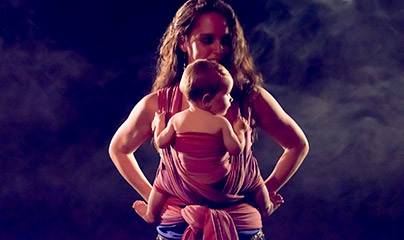 Bellydance classes only for expectant and new mothers: Why? How? Where ? Sarah COLIN, a well-known Bellydance teacher...Read more
 -
 Between funny anecdotes and real life experiences, you will love and necessarily identify with this column written...Read more
 -
 Passion, frustration, fear, pride, well-being... Being a dancer is to ensure one's performance but also juggle with...Read more
 -
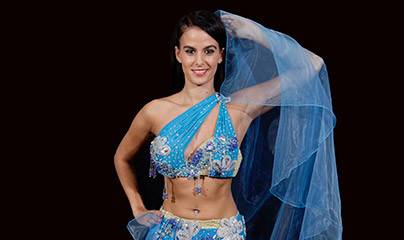 It's decided, your passion for Bellydancing is overflowing and you want to start your career as a professional...Read more
 -
 Discover the fascinating path of VAINA who practices her passion and job in Dubaï. A unique place and she shares with...Read more
 -
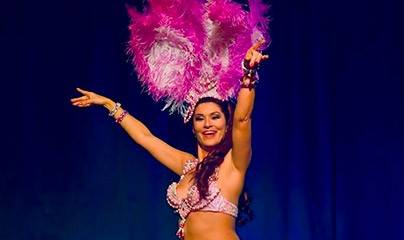 Fall for this amazing and festive merger, “Bellysamba”, through the account of Hayal, bellydancer and teacher.Read more


Leave a comment
Login to post comments