


 Mirrors, luggage, garment bags, thermos flasks...
 Floor mats, gym bags, reusable bottles, bricks…


 Gift vouchers


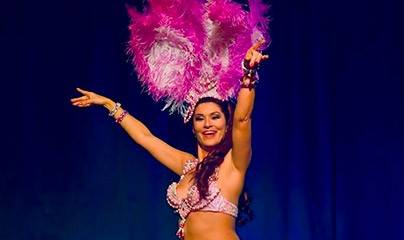
Interview with Naïra, oriental dance's prodigy
Thanks to Naïra, oriental dancer and teacher, for her detailed and fascinating answers to our interview.
Experienced and talented bellydancer, you have danced several times on prestigious stages and for public figures. Can you tell us about your most significant experiences in this field and the specific required skills?

It's true, dancing on stages such as the Palais des Congrès in Paris, the Trianon, the library of Alexandria or other theaters recognized in the world is a unique experience. One of my best on stage memories is a show in Egypt in tribute to Mahmoud Reda, with the company of Nawal Benabdallah, where troupes from all over the world performed his choreography. It was both an honor to be able to dance his choreographies in front of him and for him, and an exceptional moment of sharing with all these international artists.
I also had the opportunity to dance for celebrities, at private events, film shoots or TV shows, so I was able to meet a lot of people and experience exceptional emotions. For example, I can name the program "hezzi ya nawaem" which was broadcast on LBC (Lebanese channel), and gave me the opportunity to meet oriental dancers such as Nagwa Fouad or Amelia Zidane, as well as others artists from all over the world.
These events did not generate additional pressure for me because I'm used to always doing my best regardless of the stage or people watching, but it is true that you have to know how to adapt and accept the imposed changes; to meet the demands of productions, we cannot always do what we would like to in terms of movements or even Bellydance costumes.
You've had more than 15 years of experience in teaching oriental dance. What do you like so much about passing this art on to others?
I have been teaching Bellydance for almost 18 years now, and it is a completely different experience compared to my career as a dancer on stage and in events. Indeed, in a performance, we bring joy visually, we leave a memory to the people who watch us. In teaching, we hand down a passion; our students can feel better about themselves through dance, know their body, appreciate oriental music, but also surpass themselves by learning choreography and going on stage. Lots of students tell me at the start of the year that they won't be attending the end-of-year gala because they don't think they're up to it... And finally, they manage very well and are proud and amazed themselves at the progress made, and to be able to show their work on stage. That's where the oriental dance teacher's job brings something different, a pride in being able to share knowledge and even sometimes, "transforming" students.
What are the big projects or dreams that you still have to accomplish in the Bellydance's field?
I have been fortunate enough to accomplish many of my plans and dreams in my career when it comes to stages I walked on, shows I put on, and various events I attended. Now, I would like to hake my students dance as much as possible and encourage them to take the stage because, in my opinion, the stage is totally part of the learning process. It allows you to set an objective and progress quickly.
Thanks to my experience of many years in the event industry (weddings, company evenings, galas...), I also wish to continue to develop varied, quality services, with elegant and professional belly dancers, which is unfortunately not always seen in this domain...
Muwashahat is more and more popular these days in the oriental dance's world. As an accomplished belly dancer and teacher, can you tell us about this style in detail?
Muwashahat (or muwashah) is a poem, from 5 to 7 verses. It comes from Andalusia and was developed in Egypt and Syria. It is set to music with a particular rhythm. It is a gentle, very elegant dance with a lot of movements during which you usually hold a small scarf in each hand. I really appreciate it, as do many other dancers!
Mahmoud Reda created his muwashahat dance style with costumes consisting of large pants covered with veils, a fitted velvet waistcoat, and a headdress. Nowadays different oriental costumes are adapted for dancing the muwashahat, but they have the common characteristic of being most often very fluid, loose, and with a lot of veils.
What's your favorite Bellydance accessory and why?
It may be surprising but above all I prefer dancing… without accessories! I think you can concentrate as much as possible on your dance and how it feels. But of course, I find a part or an entrance with accessories very pretty. Visually, I would say that the new accessories (like for example the Isis's wings) are very well appreciated so I like to use them for their rendering. But I would say that, as a Bellydancer, the most pleasant accessory to handle remains the veil because it is fluid, aerial, and perfectly accompanies dance movements. I prefer oriental dance veils in silk which are lighter and offer many visual possibilities.
What's your taste when it comes to Bellydance costumes?
I can like completely different styles, from loose oriental dance costume to close-fitting, open, and modern costume, I really work following my heart and according to my whims of the moment! This is why I must have a lot of them because I need all styles and colors :-) What I can say is that I love having unique creations that are unlike others. In fact, for most of my Bellydance costumes I did the design beforehand, then ordered them from trusted seamstresses in Egypt.
Do you wear a specific outfit to learn and teach oriental dance?
I like to wear an outfit that I'm comfortable in, so no tough materials. I always wear tight pants, a dance suit, or leggings, in order to clearly visualize the movements I show in class. I also prefer that my students have pants so I can see their foot and leg positions well, and thus correct them if necessary. Then I like to accessorize my workout outfit with cute belts with beads, a dance top, and a bolero at the beginning of class while warming up.
What is you favorite oriental song and why?
It's difficult to only choose one song… I love so many of them! But if I had to choose one then I'd say "Betwanees beek" of Warda. I love the soft melody, and the rhythm that changes and accelerates at times, the unique voice of Warda that takes and transports us to dance while vibrating to this song.
Posted in: Oriental dancers
Related posts
-
 Bellydance classes only for expectant and new mothers: Why? How? Where ? Sarah COLIN, a well-known Bellydance teacher...Read more
 -
 Between funny anecdotes and real life experiences, you will love and necessarily identify with this column written...Read more
 -
 Passion, frustration, fear, pride, well-being... Being a dancer is to ensure one's performance but also juggle with...Read more
 -
 It's decided, your passion for Bellydancing is overflowing and you want to start your career as a professional...Read more
 -
 Discover the fascinating path of VAINA who practices her passion and job in Dubaï. A unique place and she shares with...Read more
 -
 Fall for this amazing and festive merger, “Bellysamba”, through the account of Hayal, bellydancer and teacher.Read more


Leave a comment
Login to post comments