


 Mirrors, luggage, garment bags, thermos flasks...
 Floor mats, gym bags, reusable bottles, bricks…


 Gift vouchers


Anne : Bellydance's rising star
Thanks to Anne ELARZA, oriental dancer and teacher, for answering our various questions during our interview.
You recently gave a workshop on the theme "Oriental Jazzy". Why this original mix? And what is it? What kind of choreography did you put in place?
 The Oriental Jazzy workshop I gave in Nantes on January 30, 2022 was devoted to a choreographic learning of the song "Etazalt El Gharam" (translation: "I gave up on love"). The song is performed by Majida El Roumi, a Lebanese singer I particularly like, not only for her elegance and the beauty of her soprano voice, but also for the poetry in her lyrics. This song is a very successful association between oriental musicality and the syncopated melody of jazz, which mixes saxophone, piano, drums, derbakeh... My goal during this workshop was to offer a gesture which spread through these two musical trends. In particular, in this choreography I wanted to emphasize the Lebanese stylization of Bellydance, as opposed to the so-called "Egyptian" oriental dance.
You are the writer of a thesis on oriental dance. In what context did you carry out this work and why did you approach this theme? And what are the conclusions?
As part of my studies done in parallel with my professional oriental dancing career, I trained in human movement sciences at the University, that is to say in anatomy, physiology, biomechanics, learning and motor control... First to enrich my Bellydance's practice and teaching, but above all because I am passionate about the analysis of human movement. Doing research in this area is driven by various exciting questions such as: How do we manage to produce complex movements? How do we become expert in a movement? Answering these questions by applying them to oriental dance as part of a doctorate seemed obvious to me, but also to the university lab which welcomed my project.
Summarizing here in a few lines four years of work and a 150-page thesis is not easy... But to put it simply, my thesis' goal was to analyze the "hip shimmy" movement, among dancers and beginners, using indicators and concepts from scientific research. In a near future, I hope I'll be able to share my research within the community. I am currently thinking how, so that the subject is sufficiently popularized and anyone can understand the concrete applications of research to their own dance practice, without prior possession of scientific background.
What is your background in oriental dance? How did you come to know and like this discipline? How did you start to dance on prestigious stages and teach this art?
I have been immersed in Lebanese music since I was a child through my family roots: for as long as I can remember, I have always loved dancing and creating small shows whenever I could. I started with modern jazz, salsa, hip hop, a bit of classical dance... Then I took my first Bellydance lesson with Sonia Shaäne. I then diversified my training by combining different teachers' workshops and self-taught training... But I'd say that my training took a leap when I crossed paths with Taly Hanafy and joined her company Bell'Masry. From then on, I progressed very quickly on different aspects of stage performance and group work. Although I'd mainly trained in "Egyptian" oriental dance for many years, today I draw most of my inspiration from Lebanese dancers of the 80's and 90's such as Amani, Nariman Abboud, or Howeida El Hachem.
I started teaching dance regularly in 2015 in the region of Paris, for children, teens, adults, beginners and advanced. I also gave thematic workshops in Paris, Lille, Strasbourg, Birmingham (UK), and more recently in Nantes, where I moved not long ago. I had several opportunities to dance in France, but also abroad during performances at different festivals: in Santorini (Greece), Italy, Spain, Portugal, Poland...
I wanted to set up artistic projects quite early on. What I love above all is the choreographic creation and the staging. When I create a show, I'd rather imagine an original narrative, other than restricting myself to the classic diagram of solo choreographies' succession. I co-founded the Nassama association in 2014, which allowed me to create several shows in this direction, mixing oriental dance and fusions, such as “Camélia, or the birth of a woman”, or “1001 colors of Paris”. In 2019, I organized in Paris with Lauriane Mj an intensive weekend of workshops, shows and open stage in honor of the Russian dancer Vaagn Tadevosyan. For this show "The Prince's Heart", we staged a real danced tale, and all the guest artists (Vaagn Tadevosyan, Maïssane Narjis, Narjisse, Bell’Masry, Kazafy Troupe France) brilliantly played the game. This event was a great success, and attracted dancers from all over the world.
Bellydance, like other performing arts, is strongly impacted by the health crisis. If you had to imagine an idyllic scenario to exit the crisis and an ideal future for oriental dance, which would it be?
What I hope with all my heart after coming out from the health crisis is a rapid return of oriental dance performances, accompanied by a resurgence of popularity with the general public. I miss the feeling on stage: an indescribable bond is created between the artist and the audience, very positive and loaded with beautiful energies. Likewise, when I am a spectator, I love to see how artists go beyond themselves through oriental dance and it is a real pleasure to admire with my own eyes an artist discovered on the net.
Traveling and dancing with enthusiasts from all over the world was an integral part of Bellydance in our time, and unfortunately the health crisis deprived us of this international dimension quite suddenly. However, I think we must see this crisis as an opportunity to bounce back and rethink our events, if it were to continue: perhaps will we design events more locally, by focusing on French artists more? Perhaps this is the opportunity to devote ourselves even more to the influence of oriental dance in France and bring cultural events to life on a national scale? The question is out.
Other than Bellydance, what other performing arts do you like and why?
I have great pleasure in going to see all kinds of dance performance, I find it very inspiring. Two disciplines particularly hold my attention, because they require great physical qualities while remaining at the same time very aerial. First pole dancing; for example, I admire Marion Crampe who offers very creative, flowing and moving compositions. Then figure skating; I am captivated by the duo performances of Gabriella Papadakis and Guillaume Cizeron, who seem to float above the ice as they are so graceful and in perfect harmony.
Also, when I go abroad I take the opportunity to see a local folk dance performance as soon as possible. For example, I went to see a Cypriot dance performance while staying in Cyprus recently. I love discovering and seeing how we celebrate dance around the world; we learn a lot about people's customs.
What's your Bellydance's favorite accessory and why?
Honestly, I prefer to dance without constraint, and therefore without accessories, to give my body the possibility to express itself. Nevertheless, I really like the softness of the shapes that a silk veil naturally takes when it accompanies my movements, or in chiffon for a retro feel. I also have a soft spot for the cane, whether it's to dance saidi, baladi, jazzy fusion and even dabke.
The item that I particularly like in your shop would be the Bellydance belt with fringes: very trendy among Lebanese dancers, it perfectly emphasizes the hips' accents. Perfect for a wild solo drum!
Discover Anne ELARZA in a video:
Posted in: Oriental dancers
Related posts
-
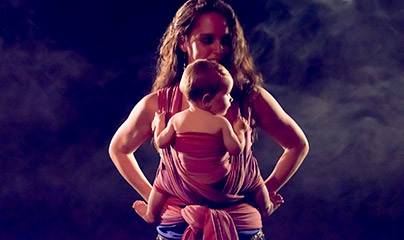 Bellydance classes only for expectant and new mothers: Why? How? Where ? Sarah COLIN, a well-known Bellydance teacher...Read more
 -
 Between funny anecdotes and real life experiences, you will love and necessarily identify with this column written...Read more
 -
 Passion, frustration, fear, pride, well-being... Being a dancer is to ensure one's performance but also juggle with...Read more
 -
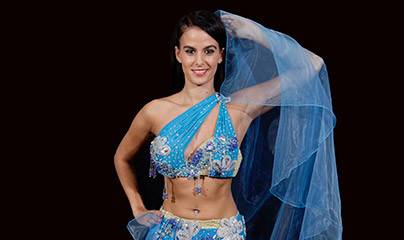 It's decided, your passion for Bellydancing is overflowing and you want to start your career as a professional...Read more
 -
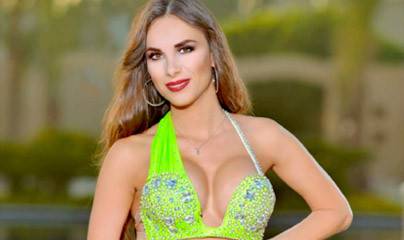 Discover the fascinating path of VAINA who practices her passion and job in Dubaï. A unique place and she shares with...Read more
 -
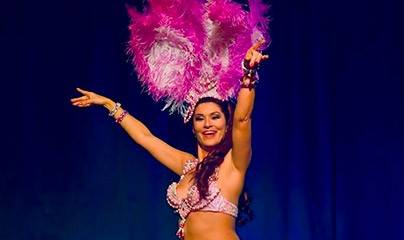 Fall for this amazing and festive merger, “Bellysamba”, through the account of Hayal, bellydancer and teacher.Read more


Leave a comment
Login to post comments