


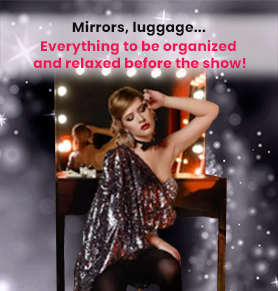
 Mirrors, luggage, garment bags, thermos flasks...
 Floor mats, gym bags, reusable bottles, bricks…


 Gift vouchers


Bellydance or yoga?
Thanks to Ursula and Eva, 2 talented dancers and teachers of oriental dance, gypsy dances and yoga for discussing the foundations but also the similarities and disparities of each of these disciplines. We discover 2 professional and passionate personalities filled with generosity, resilience, kindness and empathy. Everything we love!
Along with Bellydance, you teach yoga. What does this activity consist of?

Yoga was born in India a long time ago! It is customary to take as a benchmark the writings of Patanjali, the yoga sutras, which are found between the 2nd century BC and the 4th century AD. Patanjali being according to some theories a philosopher and grammarian or to other theories, a school of thought.
These writings describe yoga's philosophy in 8 families of principles which are:
- Yama : the principles to apply in one's relationship with others (honesty, non-violence, etc.)
- Niyama : the principles to apply in one's relationship with oneself (purification rituals, contentment, etc.)
- Asana : postural practice
- Pranayama : breath control
- Pratyahara : the withdrawal of the senses inwards
- Dharana : concentration
- Dhyana : meditation
- Samadhi : awakening or self-realization
It is clear from reading these principles that yoga is not limited to physical practice but also includes a spiritual dimension, which makes it so rich and powerful.
Below, we will only mention 2 types of yoga that are of particular interest to us, without forgetting that there are many others (ashtanga, Iyengar, kundalini, yin...).
Hatha yoga : This is the best known and most taught style. A session is characterized by a relatively small number of asanas and a rather static practice, that is to say you hold the postures quite a long time. The focus is on the breath in the posture.
Vinyasa yoga : It is a form of yoga emphasizing the postures' sequences to create a moving meditation. The focus is on the coordination between breath and movement. The postures' sequences in vinyasa are not codified and can vary at the whim of the teacher.
We offer a teaching at the crossroads between hatha and vinyasa, with sometimes static and sometimes dynamic phases. Trained and rather oriented towards vinyasa for the energy's circulation it brings and the freedom of creation it offers, we use the hatha (softer) to learn new postures and respect the beginners' rhythm of learning. This mixture of styles offers, in our experience, a class accessible to all, both beginners and connoisseurs of a slightly more dynamic yoga.
Our yoga classes are prepared and adapted to the time of day and seasons' rhythm of where they are taught. Each course is to be taken as a series of proposals to be adapted to your own daily shape. We give group lessons to individuals, in companies / communities and online.
A typical course :
- Connecting to the breath and body, often lying on the back to allow everyone, even beginners, to relax.
- Breathing exercises
- Soft sequences on the back in coordination with the breath to prepare the body for postural practice.
- Faster sequences, standing and/or on the ground, always in coordination with the breath.
- Sitting postures
- Back-to-the-floor postures
- Relaxation
The atmosphere is studious but relaxed, laughter is welcome, we all walk in a good mood towards better self-knowledge, a body in good shape and a more serene mind.
Eva : “What I particularly like is bringing those around me to live a little more in their bodies. By practicing asanas and the pranayama, we communicate with our body. It is essential to listen to feelings to be able to approach a posture, feel if there is stretching. Above all, it seems to me that it is about finding the right stretch, the right practice, what is right for you. Therefore you have to establish a state of balance, between effort and letting go. It's strange how people assimilate yoga with flexibility. Lots of people tell me: “Me, I'm stiff as a post, I can't come to your class." So I believe my role is partly making people discover yoga, deconstructing all the clichés, the preconceptions that the success of yoga may have brought about. Many people have the advanced postures in mind, and come to do them, in bewildering haste. So what I try to teach is patience, acceptance of oneself, of one's flexibility and abilities in the moment. My students gradually let go of what they had in mind, everything they saw in magazines and on Instagram. I think the real flexibility is that of the mind. I also talk about the importance of moderation, avoiding extremes to avoid the losses of balance and the associated risks. So, acceptance makes us stop wanting what we do not have. We are then grounded in reality. What huge power to draw the attention of these yogis to their breath or to this or that part of their body. I feel like a guide. Like a forest guide, I take the ones who want for a walk in their body to connect with themselves. If they manage to feel good in some movements, approach new sensations, explore new body parts, then I am happy.”
What are the similarities and disparities between oriental dance and yoga for the students, particularly in terms of physical and sports training on the one hand and the well-being on the other?
These 2 disciplines are complementary in our practice and therefore it is quite natural that we teach them to offer this complementarity to our students as well.
Ursula : “ Yoga is for me a very rich activity in which I draw my resources for calm, I refocus, take care of my body in a very rigorous way. It brings me discipline in my work on the body: flexibility, tone, breathing, concentration, balance, meditation. I must admit that it is not always easy for me to let dance and yoga live in my life in equal parts: sometimes one takes over the other, it depends on the periods.
In my opinion the main difference between yoga and oriental dance is the music because it brings me joy and makes concentrating more difficult than when I practice yoga. Indeed, the exaltation provided by music takes me away from a state of full consciousness.
One of the aspects of yoga that really appeals to me is its therapeutic dimension. Both personally and as part of my teaching, because I think it is essential to know your body well to keep it healthy and heal it if necessary. And yoga brings us this knowledge through interiority, our body's reappropriation , which is sorely lacking in our Western medicine so focused on the cure and so little on prevention.
For me, the main difference between yoga and Bellydance is the aesthetic dimension of dance, which is not sought after in yoga. Of course, a sequence of asanas practiced diligently is beautiful, but that is not its objective. As proof, the use of the mirror which is quite important in dance and does not exist in yoga.
In terms of feelings at the “end of class”, according to our students' feedback, it seems that joy is more present in Bellydance classes, through the use of music on the one hand, and dancing in a group on the other hand. Yoga brings a lot of physical well-being and serenity, all in a more individual practice.
In my opinion the great similarity between the two disciplines is the possibility of putting the “mind on hold” and reducing or even stopping its fluctuations thanks to movement.”
You teach in pairs. What are your backgrounds as oriental dancers and teachers?
Eva : "Being the youngest of the siblings, I benefited from my two sisters' passion for dancing.
I naturally started by taking modern jazz and contemporary dance classes in schools in my region. At the same time, I followed a classical musical training by practicing piano from the age of 5 until I was 18 years old.
Music and dance are part of my life.
It was at home that I learned Bellydance, around the age of 13. We worked on the basic techniques with the help of videos and from time to time, I went with my sister Ursula to Paris for her oriental dance workshops.
When I was 16, Ursula offered me my first Parisian stage during one of her shows.
I took advantage of my studies in Paris to follow dance classes at a good level and on a regular basis. And I had the opportunity to participate in a number of shows, and even to perform solos on stage.
Later I decided to take a gap year, before starting my master's degree in Teaching, Education and Training to fully devote myself to this passion.
And then, we met the excellent gypsy dance troupe of Petia Yurtchenko, a Russian gypsy choreographer trained at the Romen Theater in Moscow, which we quickly integrated.
Tap dancing is a revelation, music and dance become one!
My master finished in Aix-en-Provence, I finally decided to devote myself to the performing arts and to set up a project with Ursula in my region.
Back in Compiègne, we created the Roza company, a duo of oriental and gypsy dances. We offer Bellydance, gypsy dance and yoga lessons in the Danse Studio, at Irène Jouhet Soler, in downtown Compiègne.
We regularly collaborated with Vincent Martin, actor and founder of the Acte Théâtrale in Margny-les-Compiègne. We took part in the street arts festival “Les Années Joué” near Tours in 2018.
And a few years later, Vincent invited me to attend an original creation, followed by a tour of Kurdistan (Iraq), with young French, Kurdish, Syrian and Turkish actors in the country's major cities, but also in some refugee camps. The experience is strong in emotions and very enriching for me culturally. It's an opportunity to learn Turkish and regional dances and even to learn Arabic.
I later deepened my gypsy dance's knowledge, in particular with a trip to Romania.
After being deprived of my job for two years (covid crisis and injury), it is with great joy that I resume my activity. Beyond the technique of steps, movements, my lessons offer moments of exchange with the students (children, teenagers and adults of all ages), moments of softness, benevolence, freedom and joy.
Finally, rather than teaching, what seems essential is sharing.
Dance is a great playground, where we can meet and externalize our emotions, live them fully with our whole body, be free to tell all the stories.”
Ursula : “Since I was little, I've loved dancing. Contrary to what is often thought, my parents are not professional musicians or dancers but they have in them this love of music and dance that they were able to pass on to their children. As a child, I practiced as a teacher and choreographer with my family and friends through the organization of family shows, and from the age of 7-8, I took ballet lessons, then modern jazz, to which I devoted myself with more passion. At the same time, I followed musical training and studied piano from when I was 3 to 18. This musical training helped me develop my ear, sense of rhythm and love of music which still and always guides my career and choices in dance. At that time, the weeks were so busy between school, dance and music lessons!
As a teenager, spotted by a former competitor who gave aerobics lessons in my dance school, I practiced artistic aerobics in national competition for 2 years. Thanks to this experience, I learned a lot about intensive training and performing. After this immersion in the environment of intensive competition, I missed dancing and it called me back. I then continued learning through various modern jazz courses during my high school and university years while studying environmental economics.
Then, as a young woman, I discovered Cuban salsa which I practiced as a couple for 3 years with lots of joy.
At 22, I decided to devote myself intensively to oriental dance and I discovered a real passion with the feeling of having found "my" dance. Self-taught to acquire the basic techniques, I then took regular lessons but trained above all through intensive courses given by renowned Egyptian teachers and in particular Aladin El Kholy, Khaled Seif and Gamal Seif, a trio that brought me a lot through their sharing of Egyptian culture. I also trained occasionally with Tito Seif, Khaled Mahmoud, Dina, Jillina, Yousry Sharif, Wael Mansour, Mohamed Kazafy...
Starting 2008, I collaborated quite briefly with a few Parisian companies (Compagnie Tellurgie by Assia Guemra, Compagnie 1001 nuits by Gemma and Djamel Mellouk) then I joined the Egyptian folklore troupe of Aladin El Kholy (Bonn, Germany) in 2009 , which I belonged to for 2 years. The work with this folklore company and a trip in Egypt allowed me to discover even more Bellydance and its culture.
In 2010, I started with the great adventure of teaching and I began to give oriental dance lessons at the Kim Kan dance school (Paris 20th arrondissement).
In 2012, I took a new step with the creation and staging of “Naissance – Al Mawlid”, a show that I produced in collaboration with Zomzom, and Marc de Frutos who created the audiovisual part. This show introduced different oriental folklore through a timeless love story and received a very enthusiastic welcome from the Parisian audience.
In 2013, for the love of Russian gypsy music, I turned to gypsy dances, especially from Russia, and I met Petia Lourtchenko, with whom I trained for almost 3 years. I was also able to tame the Romanian gypsy dance during a trip in Romania in 2013.
In 2015 and 2016, I organized two oriental and gypsy dance shows at the Ménilmontant theater and then at the Clavel theater to offer a quality stage to my students.
Then I trained in vinyasa yoga, a form of dynamic yoga close to dancing. With this training I was able to deepen and consolidate my knowledge of anatomy and moves' physiology, for a dance that respects the body. With a degree from the French Yoga Federation and Yoga Alliance, I have been teaching yoga since 2017.
I also continue my activities as a dancer and I am occasionally invited to the Parisian stages to share the dance which is mine: an oriental dance spiced up with gypsy movements and which speaks a language common to the Eastern and Western worlds. All of it stretched out and anchored by work on the asanas.
Today, I'm also lucky to form a duo with my beloved sister: the name is Roza. We offer classes and shows in oriental and gypsy dance for the love of dance and the joy of working together. This duo is fortunate to be on stage with musicians, the Rozicians, with whom we share a repertoire of gypsy dances and music.”
You also teach gypsy dances from different countries: Romanian gypsy dance, Egyptian gypsy dance and finally Russian gypsy dance. What are the characteristics and specificities of each ones? What do you like so much in this type of dance?
There are at least as many gypsy dances as there are countries these people crossed. The best known and most academic is flamenco, Andalusian gypsy dance. But there are also: Indian, Russian, Romanian, Hungarian, Greek, Turkish, Egyptian gypsy dances, but also from Latin America (Peruvian for example).
They have common characteristics and in particular: foot strikes (bare or in heeled shoes), finger snaps, finger cymbals (crotales, castanets or even zills), body strikes, jumps...
Below we explain a little bit more the ones we are working on.
Russian gypsy dance : The Russian gypsy dance is a dance of character, spirited, joyful and passionate. You dance it wearing flamenco shoes, the women are dressed in a large traditional skirt, and the men in a fitted outfit (generally pants, shirt and bolero). It is characterized by a rather complex tap-dancing, common to men and women, body percussion (rather masculine), shoulder vibrations and very loose skirt movements (for women). This is the main dance we teach.
Romanian gypsy dance : There are at least 2 types, each specific to a type of music: the manele, a more oriental dance, centered around the pelvis, and the cingaralas combining jumps, foot strikes and body percussion. Romanian gypsy dances are particularly fast and bouncy, full of vitality. The traditional women's costume is made up of a colorful skirt, with flowers, very loose and in a pleated fabric.
Egyptian gypsy dance : One theory assumes that the gypsies left from northern India (Punjab) to split into two main ways from Iraq, one towards Europe, and the other towards the south. Threfore the gypsies of Egypt would come from this second great route. The dancers of this population are called the Ghawazi (sing. ghaziya) which means “conquerors”. They danced in the streets and festivals of Cairo in the 18th and 19th centuries until 1834 when they were banished by Mohammed Ali and found refuge in Esna in Upper Egypt. Their dance is characterized by foot strikes, good grounding, pelvic vibrations and some acrobatics (bridge). They dance with finger cymbals. Their costume is colorful (harem pants, blouse and girdle or long galabeya depending the era), decorated with coins (once all their wealth could be worn in jewelry or sewn onto their clothes), and adorned with a turban on their head.
For us, the gypsy dance is first and foremost music that “speaks” directly to the belly by expressing intense emotions: great joy or huge sadness but always against a background of wisdom and acceptance of life's vagaries.
It is also a dance that brings together men and women in similar movements which answer to each other, but in complete freedom and without guidance. Therefore the woman is completely free to express her character and femininity: her dance is flirtatious, lively and sensual, with large movements of the skirt, precise tap dancing, nimble jumps and embellished with shoulders' vibrations. As for the man, he has several tools at his disposal to express his vitality and masculinity through body percussion, the precision of his tap-dancing and neat postures.
The course is often a beautiful moment of shared joy, where you learn to dance while having fun.
What are your techniques to correct students during your Bellydance classes while developing their self-confidence?
It all starts with the welcome and our students' consideration: the class is open to all women and everyone has their spot, regardless of their age and level. The group cohesion is developed the first weeks by creating a WhatsApp group (primarily used to share choreography progress videos, but also allowing girls to exchange easily with each other), learning group choreography for a show, Bellydance costumes and accessories' group orders, or even organizing moments of conviviality (aperitifs, tea dances). Alongside the weekly classes, we organize occasional events throughout the year during which students from all disciplines have the opportunity to meet. We feel it's important to getting to know our students well so that they can feel comfortable and thrive with confidence in our workspace.
During the oriental dance lesson, to make sure a technique is well understood after an initial explanation intended for the group, we take a look at each of our dancers and give them some clarifications based on the observations. If someone is having difficulty, reproducing the movement next to or in front of her/him can help. Another way to correct her/him can also be, if he or she wishes, to place hands on the body to make him/her understand the movement, or finally to take one's hand to show a direction.
Let's talk improvisation... What do you think are the keys to successful improvisation in Bellydance and how do you bring your students to this exercise, which is often very complicated for some, so that they find pleasure in it?
Ursula : ”In my opinion, to be able to improvise correctly, you must first know and master the vocabulary. Then, you must get to grips with the codes and the music. When the student has this knowledge, then we can work in small improvisation workshops over short periods of time so that the student gains confidence little by little. We usually approach improvisation in oriental dance class in the form of small keys: being able to propose a combination of 3 or 4x8 steps for example. It can also be handled with a little more depth during thematic workshops.”
Discover Ursula and Eva in a vidéo :
Related posts
-
 "Oriental dance, it’s easy !", "Belly dance is vulgar"... Because our boutique will always campaign to stand up and...Read more
 -
 Enjoy the cute interview of a young dancer who explains in her own words why she loves oriental dance. We love it !Read more
 -
 Bellydance classes only for expectant and new mothers: Why? How? Where ? Sarah COLIN, a well-known Bellydance teacher...Read more
 -
 We sometimes hear everything and anything about Bellydancing. Today, BellydanceDiscount.com separates for you fact...Read more
 -
 Between funny anecdotes and real life experiences, you will love and necessarily identify with this column written...Read more
 -
 Emotion, technique, staging, music, costumes. To ensure a perfect dance choreography, you need to work on each of...Read more


Leave a comment
Login to post comments