


 Mirrors, luggage, garment bags, thermos flasks...
 Floor mats, gym bags, reusable bottles, bricks…


 Gift vouchers


Oriental dance in Lebanon
Thanks to Yara, a Bellydance teacher in Lebanon, for answering our interview with enthusiasm, sincerity and insight.
What is your background as an oriental dancer and teacher?

I've always danced, and at the end-of-year galas, I would see the great and elegant Bellydancers backstage. I was impressed by their almost majestic beauty in their costume. At 14, in the middle of adolescence, something clicked and the following school year, I signed up for classes with Vélina, an oriental dance teacher in the Paris region.
Already deeply immersed in oriental music and instruments from a very young age, I discovered the technicality inherent to Bellydancing. I remember the beginnings being difficult because I had to get rid of preconceived notions concerning this discipline and bad habits I had unconsciously acquired. It was really a question of deconstructing to rebuild better. Vélina’s rigor and elegance were truly a source of inspiration. So I stuck with it and the next year was an eye-opener. I worked diligently on all my choreographies at home, rehearsing them dozens of times, and with this I was able to gain confidence and, above all, come to the next class feeling very comfortable.
It only took me 3 years to say: "Okay! I want this to be my career later and become a professional oriental dancer". This art had really become my passion and a reason to live.
After 8 years of learning and a few masterclasses attended in France and abroad, I decided to open my first Bellydance classes and teach to offer my own choreographies according to my inspirations.
Then with word of mouth and social networks I was able to open more classes and be contacted by new dance schools.
At the same time, I performed in many events in France, mainly cultural events linked to Lebanon and art in general. There, I met a wide range of artists and personalities who trusted me and saw me grow.I was also invited to several oriental dance festivals in Europe where I was able to perform, but also attend workshops given by leading figures in the field.
I have always admired these Bellydance teachers who travel the world to teach their technique.
In 2022, I left France to settle in Lebanon; it has always been my dream, even though the political and economic situation there is unstable. It was then a matter of starting from scratch, with a virtually empty contact list and a completely different approach to oriental dance. A new challenge...
Today, what is your vision of Bellydance in Lebanon?
This one is a little biased and I sometimes think I lack objectivity, but here it is... I grew up with my dance in France, in an environment where we are always looking to improve and satisfy our curiosity. I like the oriental dance's technique and love its story.
When I moved to Lebanon in 2022, that is to say just after the "thawra", the 2019 revolution, the economic crisis, COVID-19 and the explosion of the port of Beirut on August 4, 2020; the country had barely recovered and dance classes were gradually coming back to life. So I arrived by chance at a time when normal life seemed to resume.
Girls wanted to let off steam and escape. Here, students are more interested in learning to dance for the physical activity and to reproduce the moves to current Lebanese hits in the evening than to participate in an end-of-year gala or acquire advanced technical and historical knowledge.
Therefore I had to adapt my teaching, while maintaining some principles, in order to meet my students' expectations in this country.
Here, dabke is the traditional folklore found in all celebrations.
As in every Arab country, in Lebanon, we also find the paradox of enjoying an oriental dance show as long we are not related to the dancer.
With these explanations, I think my community on social networks can then understand better why I no longer perform at cultural events and festivals since I moved to Lebanon.
In my opinion, Lebanese society is not ready to change its view of this art yet. Besides, does it see Bellydance as an art? That's why I deeply admire dancers who do not care about this social convention and continue to perform in public. Personally, I thought long and hard, and decided to make choices for the well-being of my family so as not to harm them.
What are the differences between the Lebanese students and employers' expectations compared to those in France?
As a result of my previous answer, I will only address the "teaching of oriental dance" part and not the "public performance" one and the different types of contracts that can result from it.
Operating a dance school in Lebanon is quite similar to that in France, except that student registrations are systematically done by the month and not by the year as it is most of the time the case in France. It's a well-established system that works for everyone. The downside is that the student doesn't stay in the program for long periods of time. Therefore there is sometimes a strong "turn over" and we stay on basic notions and "all levels" all year round.
What is your favorite Bellydance accessory and why?
The veil! It really fits my soft, calm, graceful and sensual personality in the broadest sense. This accessory is much less known here than the more traditional and typical oriental dance cane. Soon, I would like to introduce my students to the finger cymbals and Isis wings which I also really like.
What types of outfits do you like to wear during your Bellydance training and why?
I choose to wear slippers for practicality, they don't slip on the wooden floors and save me from having to clean my feet after each class.
Leggings that stick to the leg or shorts in the summer so I can show the feet's correct position and the work of the legs/knees with each movement. So I'm looking for something practical once again. The gaiters and little skirts are a personal touch and reflect my "mood" of the day.
Related posts
-
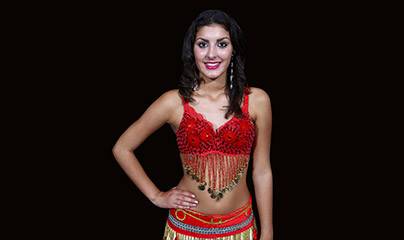 "Oriental dance, it’s easy !", "Belly dance is vulgar"... Because our boutique will always campaign to stand up and...Read more
 -
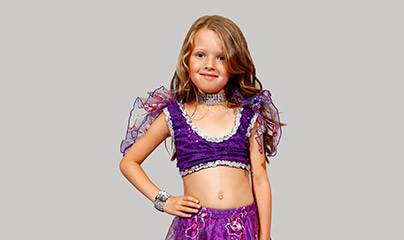 Enjoy the cute interview of a young dancer who explains in her own words why she loves oriental dance. We love it !Read more
 -
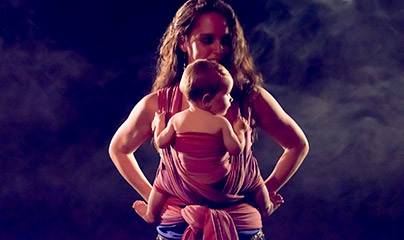 Bellydance classes only for expectant and new mothers: Why? How? Where ? Sarah COLIN, a well-known Bellydance teacher...Read more
 -
 We sometimes hear everything and anything about Bellydancing. Today, BellydanceDiscount.com separates for you fact...Read more
 -
 Between funny anecdotes and real life experiences, you will love and necessarily identify with this column written...Read more
 -
 Emotion, technique, staging, music, costumes. To ensure a perfect dance choreography, you need to work on each of...Read more


Leave a comment
Login to post comments