


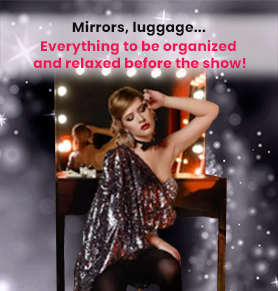
 Mirrors, luggage, garment bags, thermos flasks...
 Floor mats, gym bags, reusable bottles, bricks…


 Gift vouchers


Bellydance vs Pilates : The match!
Thanks to Stéphanie HEYRAUD, dancer but also oriental dance and Pilates teacher, for answering our questions about these 2 activities with precision.
Oriental dancer and teacher, you also teach Pilates. What does it consist of?
 The Pilates method was created by Joseph Hubertus Pilates (a German born in 1880), a man who was fragile (he suffered from asthma and rickets among others). He kept on practicing sports to improve his health and developed a lot of exercises whose effects were checked and confirmed by the general public and the medical profession. Later, this method was widely practiced by dancers and then stars in the United States. Joseph Pilates taught and trained people in his method which spread all over the world.
Pilates aims to improve posture, strengthen deep muscles, relieve the back, strengthen the perineum, improve joint amplitude and flexibility. This involves slow exercises with lateral chest breathing, the neck elongated, the shoulders low, the pelvis in a neutral position, the perineum as well as the transverse (the deepest abs) engaged, the knees flexible and the feet apart aligned with the hips.
A class begins with an osteoarticular warm-up as well as a few Pilates breathing exercises then comes a series of 10 to 15 movements where you must alternate strength with mobility exercises. We repeat each movement ten times. In Pilates, we do not seek performance but the quality of movement so that it is as effective as possible. The session lasts 1 hour and will call upon all the body's muscle groups with the center involved (perineum + transverse), everyone at their own pace, on their own breathing. We end the class with some stretching or relaxation.
Here are some exercises :
- Shoulder bridge: on the back, legs bent, raise the pelvis by contracting the buttocks ;
- Side kick: on the side, the upper leg is raised ;
- Scissors: on your back, legs upside down, touch the ground with your toes keeping your legs at a right angle (alternate right and left).
There are many exercises, you can also use machines or equipment such as swiss ball, Pilates balloon, rubber band, foam roller, magic circle...
The lesson's atmosphere is zen and relaxed, concentration is very important.
Pilates is practiced by everyone: dancers, top athletes, injured people, pregnant women... it is suitable for everyone.
What are the similarities and differences between Bellydance and Pilates for the students, particularly in terms of physical and sports training on one hand and the well-being provoked on the other hand?
As for my students who practice both disciplines (oriental dance and Pilates), it is much easier for them to isolate the movements in Bellydance and have a better posture, they control their body better.
What's different is the breathing because you can't breathe in the "Pilates" way when you dance. Bellydance is more fun than Pilates. But it also requires memory while Pilates does not.
After a Pilates session, you feel relaxed. After a Bellydance lesson, you want to keep on dancing at home!
What's your background as an oriental dancer?
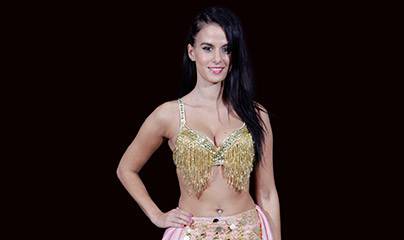
I started modern jazz dance at 7, and this for 20 years. Then I discover Bellydance in 2007, whenI was 24 years old. It was during my big brother's wedding where an oriental dancers' company was present that my passion was born. I found this dance to be sublime: the music, technical movements, the dancers' expression and grace. I signed up for Bellydance lessons right after this wedding with Nadia, an excellent teacher in Mont de Marsan, who trained exclusively in Cairo with Raquia Hassan for the most part. I then was taught by Bellydance teachers in a more modern style and then I met Maya Sarsa with whom I was lucky to take lessos for 2 years. I also went to Cairo several times, the first time with Taly Hanafy and Kareem GaD. Finally I attended a lot of oriental dance workshops and of course continue to learn from Taly and Kareem, but also Hassan Saber, Yaël Zarca, Lylia Bourbia, Kaouther...
I started teaching Bellydance in 2014, after a discussion in Cairo with Taly who told me me why not teach given my investment and my passion for this discipline. That year, Nadia had stopped teaching so I went for it! I've developed my pedagogy over the years but passed a Fitness Diploma and a Pilates certification because I was teaching by mimicry, without really understanding why I was doing such and such warm-up. After my Diploma and Pilates certification, I was able to teach in a completely different way and help my students progress faster. Some of them won national and international competitions.
As for my career as an oriental dancer, I have been dancing for events or in restaurants for more than 10 years, it's been essential to learn to improvise and adapt to all types of audiences.
How do you like to accessorize your Bellydance costume and complete your stage outfit?
I love oriental dance costumes with lots of rhinestones! In addition, I only wear rhinestone jewelry and a headband because my hair has the annoying tendency to hide my face! On stage I dance barefoot mais but in performance I wear dance shoes with heels, the work of the pelvis and the balance are much more complex so the performance is different.
Which Bellydancer best embodies your vision of oriental dance and why?
It's hard to name a single dancer who in my eyes personifies the perfection in oriental dance because Bellydance is evolving. Samia Gamal is in my opinion the emblematic dancer because she represented the grace, elegance, softness and femininity of oriental dance. Today, and in a completely different repertoire, there are 2 other bellydancers whose videos I'm tired of viewing... It's Sahar Samara that I saw dancing in Cairo years ago. I love her modern style, interpretation, technique and Saïdi. In my opinion she is the woman who masters this style (which is also my favorite folklore) the best. The second bellydancer that I follow is Julia Farid. I find that she was able to give back to the golden age a little touch of modernity with a lot of elegance. She is captivating… Moreover, she masters all the styles. Having been able to enjoy her pedagogy, I also know that she is an excellent teacher!
2 years later, oriental dance is still strongly impacted by the health crisis. If you had to imagine the ideal exit scenario for this discipline, what would it be?
I think that for Bellydance as for art in general, I would like for people to take the time to appreciate everything the artists can give on stage, in the street, theaters, dinner shows... so art can be alive again and people show an interest in it because it has been sacrificed for too long.
Discover an exceptional video of Pilates exercises danced:
Related posts
-
 "Oriental dance, it’s easy !", "Belly dance is vulgar"... Because our boutique will always campaign to stand up and...Read more
 -
 Enjoy the cute interview of a young dancer who explains in her own words why she loves oriental dance. We love it !Read more
 -
 Bellydance classes only for expectant and new mothers: Why? How? Where ? Sarah COLIN, a well-known Bellydance teacher...Read more
 -
 We sometimes hear everything and anything about Bellydancing. Today, BellydanceDiscount.com separates for you fact...Read more
 -
 Between funny anecdotes and real life experiences, you will love and necessarily identify with this column written...Read more
 -
 Emotion, technique, staging, music, costumes. To ensure a perfect dance choreography, you need to work on each of...Read more


Leave a comment
Login to post comments